Friday, December 16, 2011

Filling Wheel Wells

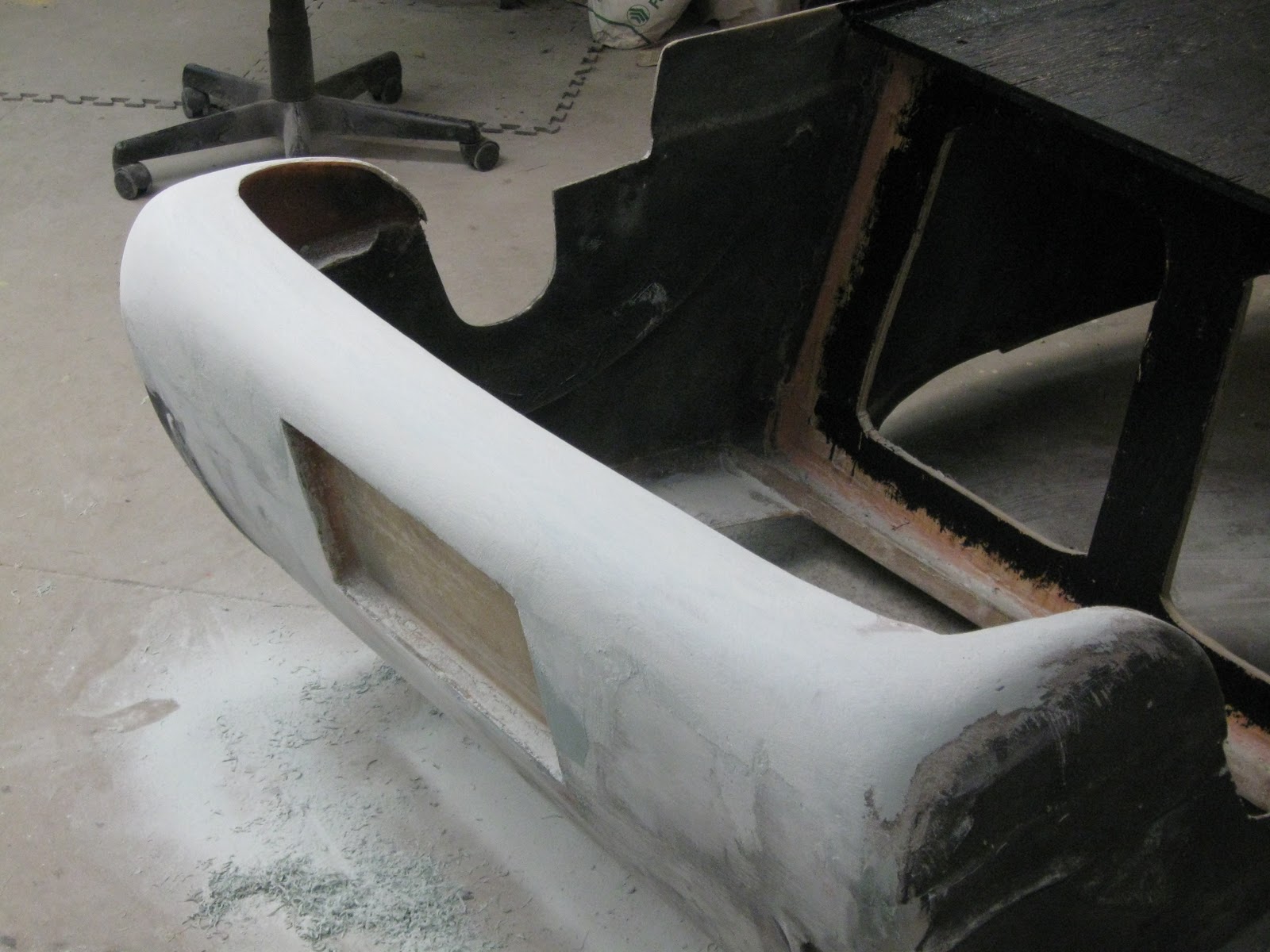
With the body flipped over, I went ahead and finished the rear roll pan by adding some fiberglass bondo and then finishing off with some ultra lite bondo.  This picture also shows the extent of the wheel cutout that I am going to fix next.


I took my flat table ,covered it with wax paper and then laid up 4 layers of 1 oz. fiberglass mat , let set up and then repeated the process and wound up with two flat pieces big enough to cover each of the openings.  I then sanded the area on the back side of the body with 40 grit sandpaper on a small hand electric sander and got all of the ridges and bumps out so that the flat pieces I just made would lay flat.  
         
Next I cut the flat pieces about two inches larger than the area to fill.  Using fiberglass bondo, I coated the inside around the opening and placed the flat pieces against the body and secured them in place with six sheet rock screws - into pre drilled holes.  Then I used a bondo spreader and smoothed out the fiberglass bondo on both sides and let set up.  This does two important things:  one ,it gives a great deal of strength  to the panel by overlapping- and two , it allows the blending of the back and the front to occur.  I could have cut the flat panel to fit the opening  and beveled both the body and the flat filler piece and then used mat on the back side and fiberglass bondo on the front and eliminated the  step in the front.  I have found that in this type of situation, that I would rather have the strength that overlapping gives than go the other route.  Not that it wouldn’t work, because it definitely would - I just wanted extra strength from the overlap.  I then blended the front with some fiberglass bondo to fill some of the lower spots and then finished off with ultra lite bondo.

Here you can see what the back side of the filler piece looks like after some extra fiberglass bondo has been spread out and tapered.  This give some extra strength and makes it look a little better.  I will build a flat panel from Luann plywood and cover it when I upholster the trunk area.  This shot also shows the back of the cockpit bulkhead and how I filled the seam with fiberglass bondo to secure it in place and make it more ridged.       


This body has a  4 inch body roll pan installed at the factory and it must have been done on a Monday or Friday because it definitely needed some extra work.  I used my electric hand sander and sanded the edges as smooth as possible where the top of the roll pan and the bottom of the body were laminated together , roughed up the gel coat on both sides and then coated the entire length with fiberglass bondo and smoothed it out.  After it set up, I again sanded the area and blended it as much as possible , filled in the places I missed or were low and then when they were cured, I used ultra lite bondo and finished blending the two together.  It actually came out quite nice.  
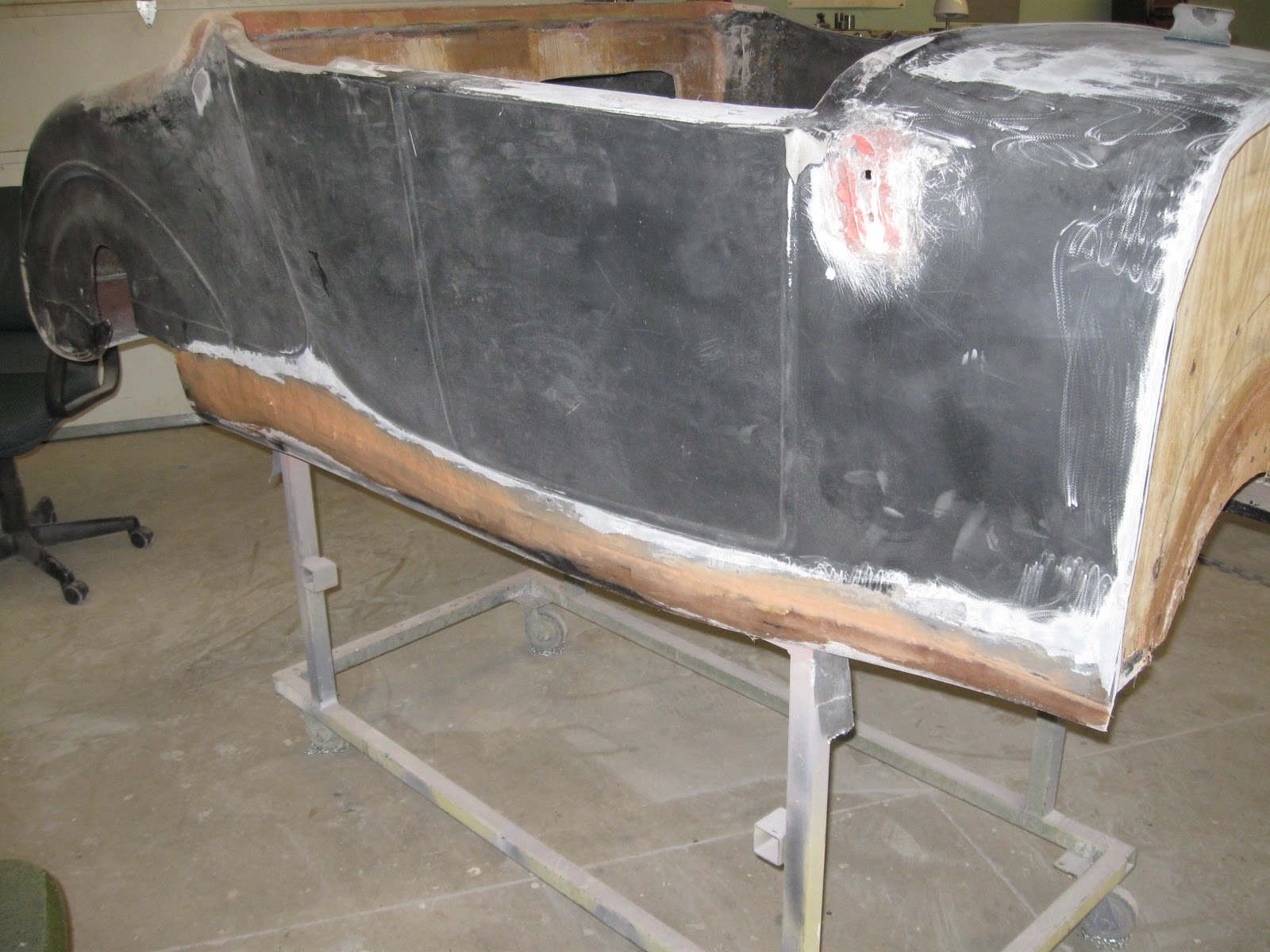

This picture shows the roll pan and the wheel well after the ultra lite bondo has been applied and sanded.  From this point, there is just a little detail work to be done, and then these areas will be ready for the first coat of urethane primer. 


Remodeling The Cockpit


Well after looking at the back of the cockpit on this roadster and realizing that I am a big guy, I decided to do some remodeling and increase the length by about four inches , this way I will sit further back and gain more room inside and wind up with a much more comfortable ride.  So here I go to build a better ride.
You can see how and where I cut the back of the cockpit and then I moved it back about four inches and laid it on top of the remaining piece and bonded it together with some fiberglass bondo.  This is really great stuff!  Whoever came up with it should be in the hot rod hall of fame.  if there is such a thing. 

Next I cut a piece of 1 x 2 inch piece of poplar and glued( bondo) it to the top sides of the body and clamped it in place.  Actually the cut piece of the body is not fiberglassed in place yet , but I wanted to show how it was cut and “glued “ down.  So I got a little ahead of myself but now it is hopefully a little clearer.

Here is a closeup of the 1x2 in place and ready for the removed fiberglass piece to be bondoed in place both on the back and on the front.

After It has set up, I took some small pieces of fiberglass matt and tied the ends to the body.  I used three layers of 1 oz matt to do this.  Then I used fiberglass bondo to finish shaping the contour so that it would blend in and flow.


This picture shows how nice the whole process came together and flowed out.


When you look at the rough finished product, it flows nicely, looks good, and the benefits from the added four inches will make this two hour remodel worth the effort.  When I get to the actual finishing of the body, I will use ultra light bondo and this will smooth everything out and get it ready for primer.  


Monday, December 12, 2011

Exhaust System

 Now that the engine , transmission, rear end, radius rods - front and rear, radiator , grille shell, and body are set up and everything seems to look like it belongs and will work, it’s time to build the exhaust system.  The one thing to keep in mind when building the exhaust is clearance.  Next , how it looks on the car and does it flow smoothly and am I going to be happy with it.  The last thing is serviceability.  Can I repair this easily or will it become a major nightmare and project?  Before starting I always install the things that get in the way and provide the most challenges when it comes to clearance.  Remember that heat is always going to be a concern around the starter, oil filter , battery cables , brake lines, fuel lines , wiring,  the floorboards, and the steering box.  I have an old starter and oil filter I use on my mock up engine to get started when building  the exhaust.  It’s always best to start at the exhaust manifold or header that is going to be used.  I try to use mandrel bent 2 inch o.d. exhaust tubing but often I use muffler shop bent tubing where it is not going to be easily seen.  Mandrel bent is the same diameter throughout the entire bend; whereas, muffler shop is smaller through the bend and standard size on the ends.  I only use 45 degree, 90 degree and straight tubing just to keep every thing simple.  By cutting , turning and using a few basic tube techniques, I can wind the tubing in and out, up and down, and over and under to create a very smooth flowing exhaust system.  If a person doesn’t want to go this way, they can just take it to a muffler shop and have them build a custom one - bring your wallet!  I start with the 1/4 -3/8ths  metal flange bolted to the exhaust manifold and will usually start on the starter side.  This will usually set the depth or length downward for the exhaust and then I can match the opposite side accordingly. 

Next  I tack a 1 x 1” thin wall length of tubing to the top of each muffler - this sets the floor clearance ( allows air to flow over the top so that heat inside the cockpit is minimal).  Then I tack two lengths of 1 1/2 “ angle  iron to each muffler ( one at each end)  make it long enough to span the width of the frame.  These are used to adjust the muffler in and out, front to rear, and allows for angle placement inside the frame rails.  In other words, it allows the muffler to be place exactly where you want it and then either tack or clamp the angle iron to the frame thus securing the muffler in place.  Then do the same with the other one.  This one shows four pieces of angle, sometimes I use just two and tack each end of the muffler and then tack the angle to the frame.  Now that the mufflers are where I want them (held firmly in place)  I can now build from the header to the muffler and from the muffler to the rear of the car and I can build the rear exhaust mount from the frame to the pipe or to the muffler and everything will stay put.  It’s nice not to have to fight the muffler while I’m building the front and rear parts of the exhaust system.

This shot shows the set up for the mufflers a little better along with the pieces that I used for the front part.  There are two ways to work with the exhaust pieces.  The first is to fit each piece and tack in place and then butt weld when finished.  The second way is to take several bends down to the muffler shop and have them open up each end so that the 2” tubing will just slide into the other piece.  They will usually do this for free or very inexpensively.  This actually makes the adjustments quicker and easier and give a much more solid connection and more rigid after welding.  I will often use a combination of the two to achieve what I am looking for as an end product.

This is a picture of the rear exhaust with two 45 degree bends and the ends have been opened up to allow the next piece to slip inside. After I have the angle I need, I tack in place for future welding.  When routing under the rear end, I will allow about 1 1/2 - 2 “ of clearance between the housing and the exhaust tubing.                                                  

Here is where hanging the mufflers really pays off.  You can see how the pipes will exit the chassis and from here I place the rear hangers off the frame to the exhaust pipe or to the muffler depending on clearance , brackets , or personal choice.  Once the rear hangers are in place , then the angle iron muffler supports can be removed.  When the exhaust is complete;  welded,painted, and installed, then I will add chrome tips after the body is mounted so the tips can be adjusted to the end of the body.  These can be tacked or screwed or pop riveted or any combination I want.


 This picture doesn’t have anything to do with the exhaust system but it shows something I do with all of my cars.  Notice the flat bar brackets coming off the frame.  These are for a removable trailer hitch.  There is another one on the other side of the frame that is hidden in this picture.  I make these out of 3/8th x 2 “ flat bar with a 3/8ths “ hole drilled for the removable hitch to  bolt to.  I may never build the hitch and yet if I need to or decide to,  then the frame or mount is already in place.  The top hole on the center bracket is for mounting the frame to an adapter when I put the frame on two engine stands for final welding , finishing, and painting.


Current Project:1927 Highboy - The hard way!

.